
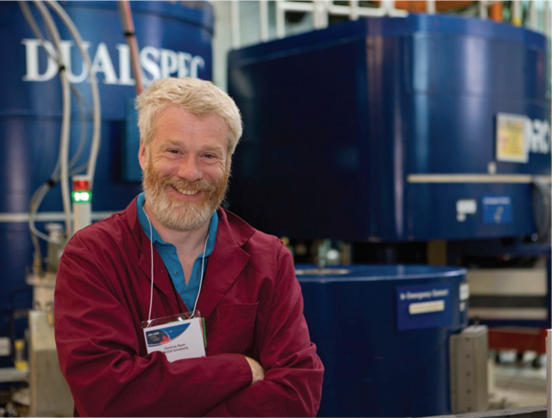
Professor Dominic H. Ryan’s passing is a deep loss for the Canadian neutron scattering community. Many of us knew him first as a scientist: a clear-thinking experimentalist whose work on magnetic materials drew heavily on Mössbauer spectroscopy, neutron diffraction, and other nuclear methods. At McGill, his research focused on frustrated and competing magnetic interactions, rare-earth intermetallics, magnetocaloric materials, and magnetic structures that often needed neutron diffraction to be understood properly. His public record includes more than 300 peer-reviewed papers and the supervision of dozens of graduate students and postdoctoral fellows.
But Dominic was more than a productive scientist. He was one of the strongest Canadian advocates for neutron scattering at Chalk River. As vice-president and later president of the Canadian Institute for Neutron Scattering, he spoke with clarity and force about the importance of NRU, the Canadian Neutron Beam Centre, and the research community built around them. During the NRU shutdown period, he appeared before Parliament and made the case that neutron beams supported not only materials science, physics, chemistry, biology, engineering, and industry, but also the training of the next generation. He stressed that graduate students and postdoctoral fellows came to NRU for hands-on training from experts, and he asked the question that still matters: if NRU was not replaced, where would they work?
For those of us who worked with him at Chalk River, that commitment was not abstract. Every year, Dominic brought students from McGill for an intensive neutron scattering course at NRU. They would arrive for a long weekend and complete a triple-axis experiment from beginning to end. They learned the real nuts and bolts: alignment, counting statistics, magnetic Bragg peaks, data interpretation, and the physical meaning behind the patterns. MnF₂ was often the teaching ground, because it made magnetism visible in a clean and beautiful way. In a few days, students saw how an idea becomes an experiment, and how an experiment becomes understanding.
That course later became the basis for a tutorial article that we wrote in 2010 for a special issue of the Canadian Journal of Physics. It was rooted in years of teaching at the beamline, and it won the journal’s Best Paper prize that year. That mattered because it captured something Dominic did so well: he turned advanced neutron scattering into something rigorous, practical, and teachable.
Dominic also pushed experiments that many people would have avoided. He worked with CNBC staff on neutron diffraction measurements in highly absorbing materials containing elements such as Gd, Sm, and Eu, using careful sample geometry and long counting times to extract magnetic and structural information that other methods could not provide. This work helped make C2 at Chalk River a distinctive Canadian capability for difficult magnetic materials.
And then there was Dominic the person. He was direct, sharp, funny, and wonderfully sarcastic. He did not waste words. Working with him could be intense, but it was never dull. He had that rare combination of seriousness about science and mischief about life.
I still remember one afternoon at Chalk River when we were running an experiment together. Dominic came to my office and said, almost casually, “Do you want to go up there?” I had no idea what he meant. He said he had his plane. Others knew this about him; I was new and did not. Of course, I said yes. We drove to the small airport in a town close by, took off, flew over Chalk River, and came back. For a few minutes, he even let me hold the controls, with a dry humor not to pull too much or we would climb too high to return. It was unexpected, generous, and unforgettable. Dominic was an experienced pilot who owned a small plane and sometimes used it to travel to conferences. For me, that short flight remains one of the clearest memories of his character: confident, slightly mischievous, and happy to share an experience.
Dominic’s legacy lives in his papers, his students, his collaborators, and the Canadian neutron scattering community he helped defend. It also lives in the practical knowledge passed on at beamlines, in the students who first learned neutron scattering at NRU, and in the belief that national scientific facilities matter because people gather around them, learn from them, and build careers through them.
He will be deeply missed as a scientist, colleague, advocate, teacher, and friend.
Zahra Yamani (Canadian Nuclear Laboratories)