CINS Presidential Candidate Statements

We have two candidates for CINS President; Dr. Zahra Yamani and Dr. Pat Clancy. They have been invited to provide a statements in support of their candidacy. See statements below.

Zahra Yamani

Senior Research Scientist, Canadian Nuclear Laboratories

The closure of the NRU reactor marked a turning point for neutron scattering in Canada. Chalk River was more than a neutron source: it was a research hub where staff built and operated instruments, supported users, and collaborated with researchers who relied on its facilities and expertise as extensions of their laboratories. It anchored Canada’s neutron-scattering legacy, from Bertram Brockhouse’s Nobel Prize-winning work to advances across physics, chemistry, materials science, engineering, biophysics, the life sciences and industry.

The loss of NRU left Canada without a domestic high-flux, high-capacity neutron-scattering facility. Sustaining research now depends on international access, complementary capabilities at home, and a connected community able to retain its expertise and help shape what comes next. CINS has a central role in that work.

McMaster’s growing neutron-scattering capabilities and the proposed Canada Prototype Compact Accelerator-based Neutron Source (PC-CANS) could strengthen the domestic research base, although neither can replace a high-flux facility. Access to international laboratories remains essential as Canada considers the longer-term possibility of a high-flux multipurpose research reactor. These different pathways need to reflect the scientific breadth of our community and the instrument capabilities, user support and access arrangements required for competitive research.

I joined Chalk River as a postdoctoral fellow more than 20 years ago and later served as an instrument scientist, conducting triple-axis and other neutron-scattering experiments and contributing to instrument development and user support. My experimental work at international facilities, together with my service as a Member-at-Large of the Neutron Scattering Society of America, has broadened my perspective on facility access and the role of scientific societies in representing their members.

Education and training have been central to my work. I have organized and taught neutron-scattering schools and graduate courses combining lectures, experiments and data analysis. During the pandemic, when laboratories were inaccessible, I organized a virtual school using experimental simulations. This experience demonstrated how creative approaches can broaden access to training while reinforcing the value of hands-on work with instruments and experienced scientists.

If elected president, I would work with CINS members to strengthen the Institute’s role as a trusted scientific voice and ensure that our collective needs remain visible as Canada’s neutron-scattering capabilities evolve. Together, we can ensure that CINS’s priorities for instruments, techniques, user support and access continue to reflect the evolving needs of established and emerging research communities. This would position CINS to provide informed, balanced perspectives on existing facilities, international partnerships and future neutron sources.

I would also build on the Institute’s education and outreach activities by supporting hands-on schools, virtual learning, mentorship and connections between students and experimental research. Greater engagement across disciplines and career stages, including with industry, can sustain the expertise and collaborations needed for today’s facilities and those of the future.

CINS’s strength lies in its members. I would be honoured to serve as president and work with the community to sustain neutron-scattering research in Canada and expand opportunities for the next generation.

Pat Clancy

Associate Professor, Dept. of Physics & Astronomy, McMaster University
Deputy Director, Canadian Neutron Beam Laboratory

It is a pleasure to stand in the election for the next President of the Canadian Institute for Neutron Scattering. I have been involved in CINS for almost 25 years, and it has had a significant impact on my scientific career. In fact, it was attending the CINS Neutron Scattering Summer School at Chalk River that originally led me into condensed matter physics as an undergraduate.

I believe CINS has a crucial role to play in expanding, unifying, and advocating on behalf of the Canadian neutron user community. We are entering a very important period for CINS, following the success of several major CFI awards, the launch of a new user program at the Canadian Neutron Beam Laboratory, and new international partnerships with neutron research facilities in the US and Europe. This is an ideal opportunity for CINS to grow our national user community, expand our outreach and training activities, and strengthen our role in lobbying for the future of Canadian neutron science.    

I am strongly committed to the success of the Canadian neutron scattering community. Neutron scattering plays an essential role in my research program at McMaster, where my group specializes in the study of novel quantum materials, such as high-Tc superconductors, frustrated magnets, and low-dimensional systems. Our research depends upon access to both neutron diffraction and neutron spectroscopy, and we routinely perform experiments at the CNBL, Oak Ridge National Lab, the NIST Center for Neutron Research*, ISIS, and the ILL. I am well aware of both the opportunities and the challenges facing many Canadian neutron users.

I have a strong record of service to CINS and the Canadian neutron scattering community. I have served on both the CINS Science Council (2018-2020) and the CINS Board of Directors (2020-present). I have organized several previous CINS meetings at McMaster, and helped to launch the CINS virtual seminar series during the COVID pandemic. I served on the committee that helped to produce the Canadian Neutron Long-Range Plan for 2025-2035, and have played a key role in the development of domestic neutron scattering capabilities at the McMaster Nuclear Reactor. I am the co-PI on the 2025 CFI project “Building a Future for Canadian Neutron Scattering, Part 2” and currently serve as the Deputy Director of the Canadian Neutron Beam Laboratory.

CINS has played an important role throughout my career, and it would be an honour to give back by helping to lead the organization through this exciting period. I believe we have a tremendous opportunity to build a stronger, more connected, and more sustainable Canadian neutron scattering community, and I would be proud to work with the members of CINS to make that vision a reality.
Canadian Neutron Scattering Symposium & CINS Executive Nominations

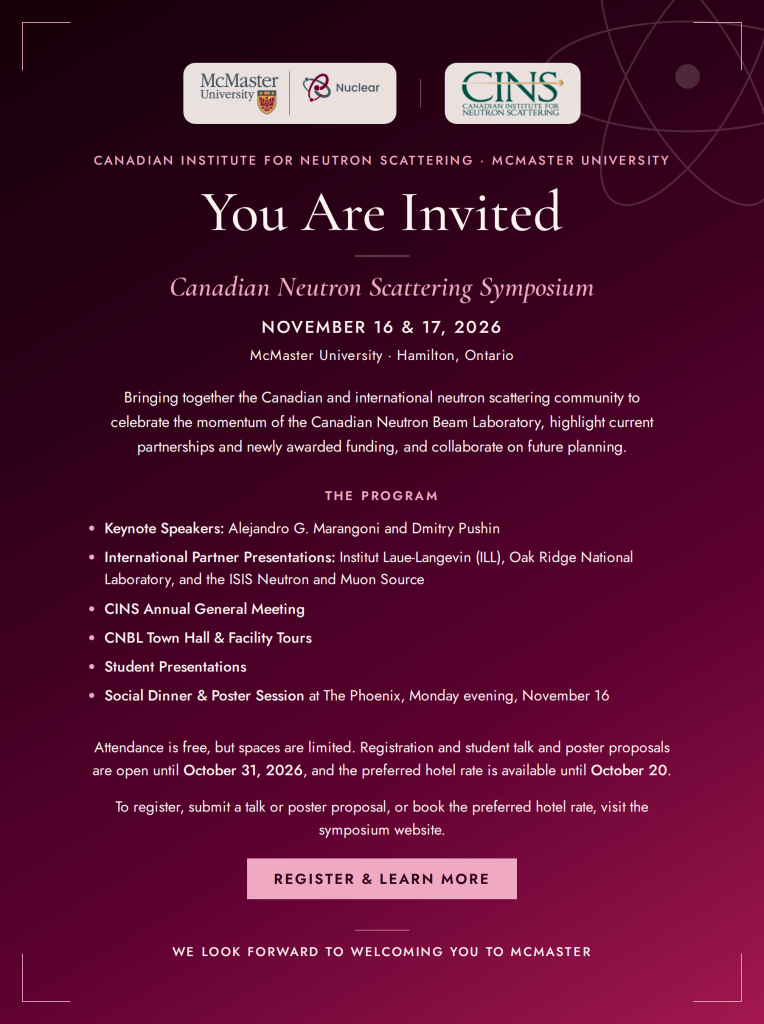
McMaster and the Canadian Institute for Neutron Scattering (CINS) are bringing together the Canadian and international neutron scattering community to celebrate the momentum of the Canadian Neutron Beam Laboratory (CNBL), highlight current partnerships and newly awarded funding, and collaborate on future planning.

We will be electing a new CINS President this year. 
If you would like to be considered, or have a nomination for President, please email drew.marquardt@uwindsor.ca by November 1st. 

2024 Annual General Meeting

CINS AGM will be held virtually Tuesday, November 26th from 1 pm to 3 pm ET. Registration can by found here.

We will be electing new officers to the CINS Executive this year. The following positions are open:
-2 open positions on the Board of Directors 
-4 open positions on the Science Council
-CINS President

Agenda

  1. CINS Elections (President, Board of Governors, Science Council)
  2. Update on the status of the NCNR
  3. Update from Neutrons Canada – John Root
  4. Update on Multipurpose Research Reactor – Zahra Yamani
  5. Update on the status of the CFI-IF 2025 application (“Building a Future for Canadian Neutron Scattering, Part 2”) – Pat Clancy
  6. Other Business

Registration

CINS Science Meeting – March 16th & 17th

CINS Science Meeting – March 16th & 17th

Registration remains open for the CINS Science Meeting to be held at McMaster University March 16th and 17th. We have a excellent program of invited talks from researchers across Canada and internationally.
Confirmed Speakers:

  • Marcella Berg (URegina)
  • Gavin Hester (BrockU)
  • Liz Kelley (NCNR)
  • Xiaodan Gu (U. Southern Mississippi)
  • Ben Tutolo (UCalgary)
  • Anand Yethiraj (MUN)
  • Jonathan Gaudet (NCNR)

There will also be a Canadian Institute for Advanced Research (CIFAR) sponsored panel session on Building Expertise for Canadian Neutron Scattering.
Confirmed Panellists:

  • Bob Watts (VP of Indigenous Relations, Nuclear Waste Management Organization
  • Jodi Cooley (Executive Director, SNOLAB)

Please register before February 27th. Registration is free.

We encourage students to submit abstracts as there will be a ‘Best Student Talk’ award sponsored by the University of Windsor.

Register

We thank our sponsors:

LRP 2022: Call For Expressions of Interest

Dear colleagues,

We are pleased to announce the call for expressions of interest (EOI) for the Canadian Institute for Neutron Scattering Long Range Plan for 2022-2050 (LRP2022). EOIs are due January 31th, 2022, via neutrons@mcmaster.ca

The LRP2022 will review the Canadian landscape of neutron beams for materials research, and will produce a list of recommended priorities for the decades to come. The CINS LRP2022 will provide single vision and unified voice for the highest priority projects in materials research using neutron beams in Canada to 2050.

We have launched a solicitation for EOIs to inform the LRP process. Chair’s of discipline specific sub-committees will review the EOIs and follow-up workshops will be held to refine the key neutron beam related needs for the different sub-committees to be synthesized into the LRP document.

Expressions of interest: An expression of interest (EOI) must be submitted in advance of the workshops. Please follow the template provided here. A EOI will be most effective and useful if it concisely summaries the idea, need or issue that the sub-committee chairs should be considering for prioritization.

Scope of EOIs: Topics may include (but are not limited to):
* instrumental needs
* foreign engagement
* auxiliary support
* science programs, science topics and science themes
* instrument design and development
* data analysis, data management and data storage
* funding issues (e.g. NSERC, CFI, funding policy for major research facilities)
* outreach, education and teaching
* training, careers, demographics and professional development
* equity, diversity and inclusion

Sub-Committees:
* Quantum Materials
* Soft Matter
* Energy Materials
* Imaging
* Industry

Authorship: Each EOI must have a designated author for contact purposes. Anonymous submissions will not be considered.


CINS AGM 2021

Save the date: 2021 CINS Annual General Meeting

November 29 and 30th


The 2021 CINS Annual General Meeting will be held virtually.  The meeting will run Monday, November 29th and Tuesday, November 30th, 2021 from 2 pm to 4 pm (Eastern).  For more details please refer to the meeting website at: cins.ca/agm-2021.  We look forward to seeing you virtually in November!

AGENDA


Day 1 Monday, November 29

  1. Welcoming remarks – Drew Marquardt (2pm-2:05)
  2. Remembering Bill Buyers – Zahra Yamani (2:05-2:20)
  3. CINS Business – Drew Marquardt (2:20-2:50)
    1. Introduce new Board
    2. Science Council Elections
  4. CFI-IF 2020 Update – Bruce Gaulin (2:50-3:25)
  5. CFI-IF 2023 Update – Drew Marquardt (3:25-4pm)
  6. Adjourned

Day 2 Tuesday, November 30

  1. Welcoming remarks (2pm-2:05)
  2. Neutron Scattering Long Range Plan Launch – Bruce Gaulin (2:05 pm-3 pm)
  3. Neutrons Canada Update – John Root (3:00-4pm )
  4. Adjourned


“Beam-based Probes of Condensed Matter Physics, Chemistry and Related Fields in Canada” Conference

TRIUMF_Logo_Blue

The Centre for Molecular and Materials Science (CMMS) at TRIUMF is organizing a virtual 2-day workshop for Thursday, June 3rd and Friday, June 4th. The motivation for this workshop is that TRIUMF is engaged in developing a 20-year vision for the laboratory and our stakeholders. There have been several areas where the community would benefit from contributions from TRIUMF, both scientifically and on technical elements. This in turn would provide the community enhanced options for studies outside of the existing program in μSR and βNMR, building new capabilities and synergies. All these ideas need to be put in context of national and international developments and competitiveness.  

This workshop is designed to enable researchers, professors and scientists at Canadian institutions and facilities to present and discuss developments, and learn from ideas at other facilities and in other research areas. It will provide opportunities for coordination and identification of new concepts. The workshop will have sessions on the following topics:

Thursday, June 3rd (all times in PDT)
08:00 – 10:00 Session 1: Novel capabilities with μSR
10:30 – 12:30 Session 2: Neutron scattering (with an accelerator-based source)
13:00 – 15:00 Session 3: Polarized radioactive isotopes
15:30 – 17:30 Session 4: Muonic X-ray analysis and μ-SR

Friday, June 4th (all times in PDT)
08:00 – 10:00 Session 5: Positron annihilation spectroscopy
10:30 – 12:30 Session 6: THz spectroscopy in Canada
13:00 – 15:00 Session 7: Synchrotron light sources
15:30 – 17:30 Session 8: μSR idea and concepts

Each session will have three 30-minute talks followed by 30 minutes for discussion. Between each session there will be a 30-minute break, where additional discussions can occur. A link to the Indico site can be found here: https://meetings.triumf.ca/indico/event/231/.  We are currently confirming the last of the invited speakers and contribution titles.

While there is no registration fee, registration is required for attendance to this conference. Please register by 11:59pm PST on Sunday, May 30th via the Indico site above. All registrants will be contacted via email on Monday, May 31st with the Zoom connection information.

Any questions can be directed to the Physical Sciences Division office at sciencediv@triumf.ca

Canadian Institute for Neutron Scattering Planning Workshop

The Canadian Institute for Neutron Scattering will be holding a virtual Planning Workshop March 4th at 2 pm ET.  This workshop will be a discussion among neutron researchers to continue to build alignment on a national roadmap and the next major funding applications. The workshop will build on the success of the CFI 2020 Innovation Fund application, “Building a Future for Canadian Neutron Scattering”, aiming to take the community to the next level.

Tentative Agenda:

  1. Daniel Banks – Neutrons Canada and the national neutron strategy: developing a detailed roadmap for rebuilding Canada’s neutron beam capabilities
  2. Drew Marquardt ­– A prototype CANS as the centrepiece for a national-proposal to the CFI 2023 Innovation Fund
  3. Bruce Gaulin – A proposal to the CFI 2023-2029 Major Science Initiatives Fund
  4. Open discussion about strategy for each of the above.

Registration for the Zoom meeting is open by clicking here.
After registering, you will receive a confirmation email containing information about joining the meeting.

Posted by / February 22, 2021 / Posted in Events