Remembering Professor Dominic H. Ryan

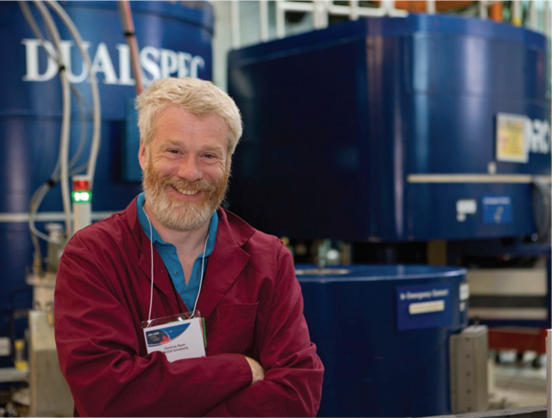
Prof. Dominic H. Ryan at the NRC Canadian Neutron Beam Centre, located at the NRU reactor at the Chalk River Laboratories, ca. 2007. (Photo: National Research Council)

Professor Dominic H. Ryan’s passing is a deep loss for the Canadian neutron scattering community. Many of us knew him first as a scientist: a clear-thinking experimentalist whose work on magnetic materials drew heavily on Mössbauer spectroscopy, neutron diffraction, and other nuclear methods. At McGill, his research focused on frustrated and competing magnetic interactions, rare-earth intermetallics, magnetocaloric materials, and magnetic structures that often needed neutron diffraction to be understood properly. His public record includes more than 300 peer-reviewed papers and the supervision of dozens of graduate students and postdoctoral fellows.

But Dominic was more than a productive scientist. He was one of the strongest Canadian advocates for neutron scattering at Chalk River. As vice-president and later president of the Canadian Institute for Neutron Scattering, he spoke with clarity and force about the importance of NRU, the Canadian Neutron Beam Centre, and the research community built around them. During the NRU shutdown period, he appeared before Parliament and made the case that neutron beams supported not only materials science, physics, chemistry, biology, engineering, and industry, but also the training of the next generation. He stressed that graduate students and postdoctoral fellows came to NRU for hands-on training from experts, and he asked the question that still matters: if NRU was not replaced, where would they work?

For those of us who worked with him at Chalk River, that commitment was not abstract. Every year, Dominic brought students from McGill for an intensive neutron scattering course at NRU. They would arrive for a long weekend and complete a triple-axis experiment from beginning to end. They learned the real nuts and bolts: alignment, counting statistics, magnetic Bragg peaks, data interpretation, and the physical meaning behind the patterns. MnF₂ was often the teaching ground, because it made magnetism visible in a clean and beautiful way. In a few days, students saw how an idea becomes an experiment, and how an experiment becomes understanding.

That course later became the basis for a tutorial article that we wrote in 2010 for a special issue of the Canadian Journal of Physics. It was rooted in years of teaching at the beamline, and it won the journal’s Best Paper prize that year. That mattered because it captured something Dominic did so well: he turned advanced neutron scattering into something rigorous, practical, and teachable.

Dominic also pushed experiments that many people would have avoided. He worked with CNBC staff on neutron diffraction measurements in highly absorbing materials containing elements such as Gd, Sm, and Eu, using careful sample geometry and long counting times to extract magnetic and structural information that other methods could not provide. This work helped make C2 at Chalk River a distinctive Canadian capability for difficult magnetic materials.

And then there was Dominic the person. He was direct, sharp, funny, and wonderfully sarcastic. He did not waste words. Working with him could be intense, but it was never dull. He had that rare combination of seriousness about science and mischief about life.

I still remember one afternoon at Chalk River when we were running an experiment together. Dominic came to my office and said, almost casually, “Do you want to go up there?” I had no idea what he meant. He said he had his plane. Others knew this about him; I was new and did not. Of course, I said yes. We drove to the small airport in a town close by, took off, flew over Chalk River, and came back. For a few minutes, he even let me hold the controls, with a dry humor not to pull too much or we would climb too high to return. It was unexpected, generous, and unforgettable. Dominic was an experienced pilot who owned a small plane and sometimes used it to travel to conferences. For me, that short flight remains one of the clearest memories of his character: confident, slightly mischievous, and happy to share an experience.

Dominic’s legacy lives in his papers, his students, his collaborators, and the Canadian neutron scattering community he helped defend. It also lives in the practical knowledge passed on at beamlines, in the students who first learned neutron scattering at NRU, and in the belief that national scientific facilities matter because people gather around them, learn from them, and build careers through them.

He will be deeply missed as a scientist, colleague, advocate, teacher, and friend.

Zahra Yamani (Canadian Nuclear Laboratories)

CINS Student Symposium & AGM – November 14th & 15th

Join us in-person this November for a student symposium (November 14th, 2025) and the CINS Annual General Meeting (November 15th, 2025) held at the Université de Montréal. Registration is open and we have a excellent program of invited talks from researchers across Canada and internationally.


Confirmed Speakers:

  • Antonella Badia (Université de Montréal)
  • Murray Wilson (MUN)
  • Jacques Huot (UQTR)

CINS Agenda (tentative)
Welcome (Drew)
-CINS Business (~30 min)
Election Next Year (Drew brief)
-Neutrons Canada update (John Root – 40 min)
-ISIS Partnership Summary
-CNBL Update (Mitch & Pat – 30 min)
-CFI 2027, 2029 Discussion (Moderate by Marcella ~30 min)
-Business arising
Complete by Noon (12 pm)

Thank you to our sponsor:

Shaping the Future of Neutron Scattering in Canada: A Successful Workshop on Applications, Instruments, and Research Reactor Requirements

Canadian Nuclear Laboratories (CNL), in collaboration with the Canadian Institute for Neutron Scattering (CINS), hosted a successful virtual workshop titled, Shaping the Future of Neutron Scattering in Canada: Workshop on Applications, Instruments, and Research Reactor Requirements. The event drew 43 virtual participants from across Canada – a reflection of the great enthusiasm within the Canadian scientific community for such a facility.

Please visit https://www.cnl.ca/shaping-the-future-of-neutron-scattering-in-canada-a-successful-workshop-on-applications-instruments-and-research-reactor-requirements/ for the full release from Canadian Nuclear Laboratories.

2024 Annual General Meeting

CINS AGM will be held virtually Tuesday, November 26th from 1 pm to 3 pm ET. Registration can by found here.

We will be electing new officers to the CINS Executive this year. The following positions are open:
-2 open positions on the Board of Directors 
-4 open positions on the Science Council
-CINS President

Agenda

  1. CINS Elections (President, Board of Governors, Science Council)
  2. Update on the status of the NCNR
  3. Update from Neutrons Canada – John Root
  4. Update on Multipurpose Research Reactor – Zahra Yamani
  5. Update on the status of the CFI-IF 2025 application (“Building a Future for Canadian Neutron Scattering, Part 2”) – Pat Clancy
  6. Other Business

Registration

World-leading neutron sources gather with Canadian researchers for consultation on the Canadian Neutron Long-Range Plan

The Canadian neutron beam user community gathered at McMaster University February 12 & 13, 2024 to define priorities and establish a path forward for Canada to invest in materials research with neutron beams in order to realize such outstanding returns—and to continue Canadian leadership in this field over the next 10 years.

Please visit Neutrons Canada for the entire article.
https://neutrons.ca/news-item/world-leading-neutron-sources-gather-with-canadian-researchers-for-consultation-on-the-canadian-neutron-long-range-plan/

Agreement signed for cooperation between Neutrons Canada and the Canadian Institute for Neutron Scattering

On July 21, 2023, Neutrons Canada signed a Memorandum of Understanding (MOU) with the Canadian Institute for Neutron Scattering (CINS). The MOU outlines several areas of cooperation between the two organizations, including, for example:

  • CINS will play a formal advisory role to Neutrons Canada on its user facing programs and activities.
  • The parties will establish a user advisory committee with an official role in Neutrons Canada’s governance structure.
  • Neutrons Canada will regularly report to users and obtain user feedback through fora organized by CINS.
  • The parties will establish regular planning processes based on formal consultative procedures that build consensus on the neutron community’s priorities.
  • The parties will cooperate on organizing events for neutron users.
  • The parties will cooperate communications to government and the public.

Visit https://neutrons.ca/2023/07/26/agreement-signed-for-cooperation-between-neutrons-canada-and-the-canadian-institute-for-neutron-scattering/ to view the full article.

CINS Science Meeting – March 16th & 17th

CINS Science Meeting – March 16th & 17th

Registration remains open for the CINS Science Meeting to be held at McMaster University March 16th and 17th. We have a excellent program of invited talks from researchers across Canada and internationally.
Confirmed Speakers:

  • Marcella Berg (URegina)
  • Gavin Hester (BrockU)
  • Liz Kelley (NCNR)
  • Xiaodan Gu (U. Southern Mississippi)
  • Ben Tutolo (UCalgary)
  • Anand Yethiraj (MUN)
  • Jonathan Gaudet (NCNR)

There will also be a Canadian Institute for Advanced Research (CIFAR) sponsored panel session on Building Expertise for Canadian Neutron Scattering.
Confirmed Panellists:

  • Bob Watts (VP of Indigenous Relations, Nuclear Waste Management Organization
  • Jodi Cooley (Executive Director, SNOLAB)

Please register before February 27th. Registration is free.

We encourage students to submit abstracts as there will be a ‘Best Student Talk’ award sponsored by the University of Windsor.

Register

We thank our sponsors:

National Neutron Strategy announcement

We are pleased to announce the release of “The National Neutron Strategy: A strategy to rebuild Canadian capacity for materials research with neutron beams.”  

The strategy represents the consensus of the community built over the past several years and was discussed in depth at the CNI-CIFAR 2020 Roundtable on a National Neutron Strategy in December 2020. The 4 key objectives of the strategy are:

1. Forge partnerships with high-brightness neutron sources in other countries;

2. Build on existing domestic capabilities, including full exploitation of the McMaster Nuclear Reactor (MNR), a medium-brightness neutron source;

3. Explore and invest in developing new neutron sources for the long term; and

4. Create a new, national governance and management framework for these activities.

This strategy is a basis for the national CFI 2023 Innovation Fund proposal led by the University of Windsor for neutron beam infrastructure, while early versions of the strategy supported the national CFI 2020 Innovation Fund award to McMaster University. Presently, 15 universities are founding Neutrons Canada as the central feature of strategic objective 4.

This strategy also serves as a basis for CINS to develop the Neutron Long-Range Plan (LRP). The Neutron LRP will be a realistic plan for the infrastructure investments needed to implement the national neutron strategy over the next decade and beyond.

The National Neutron Strategy is also available from the CNI’s page at http://neutrons.ca.